
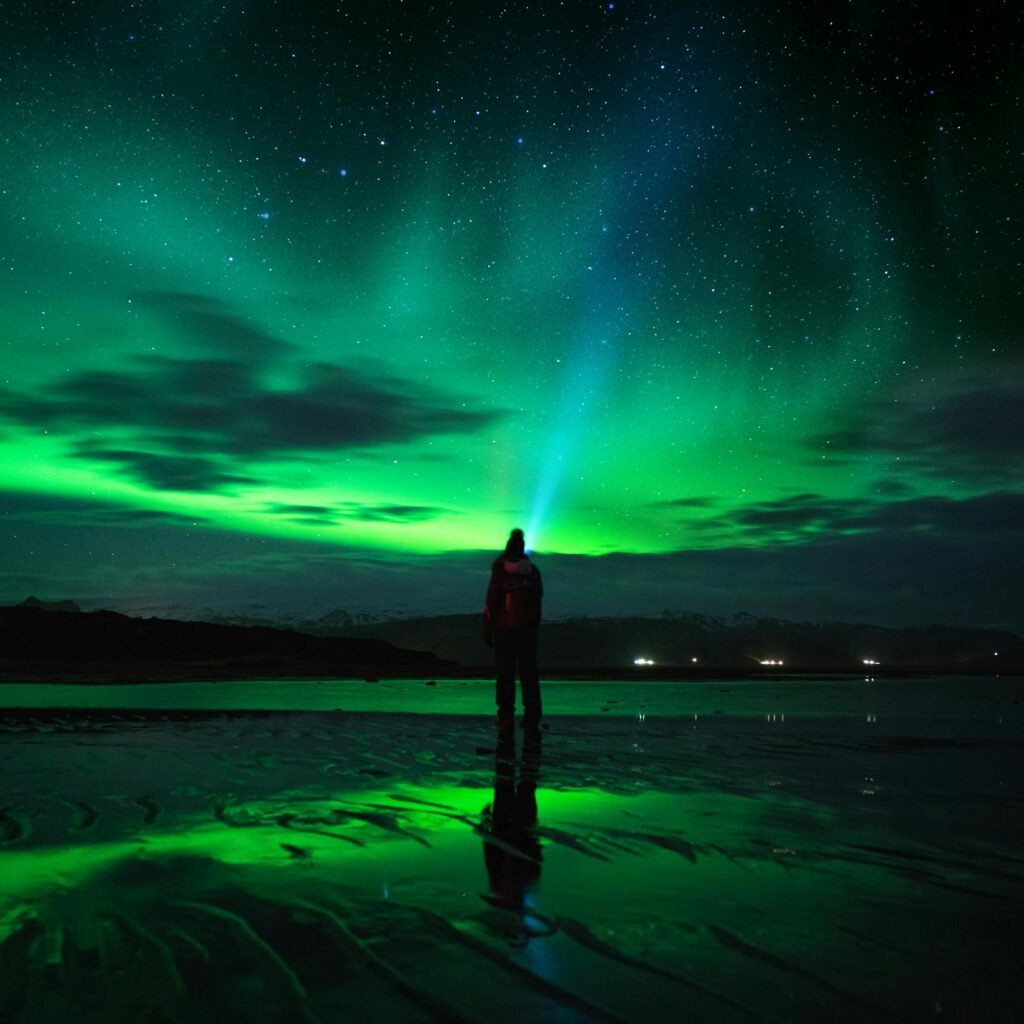
Canada is one of the best places in the world to witness the Northern Lights.
This guide explains how the aurora works, how to read KP index, best months and times, and tools you can use to increase your chances — including the real-time forecast data on this site.
Whether you’re a photographer, traveler, or curious sky-watcher, this guide will help you see the aurora more consistently.
🔥1) What Creates the Northern Lights?
The Northern Lights occur when charged particles from the sun collide with Earth’s atmosphere.
In simple terms:
Solar activity → geomagnetic disturbance → glowing lights in the sky.
Two factors matter most:
- Solar Wind Speed
- Faster solar wind = stronger auroras.
- Bz (Magnetic Field Direction)
- Negative Bz (southward) = good → allows solar energy to enter
- Positive Bz (northward) = weak auroras
📊2) Understanding the KP Index
The KP index measures geomagnetic activity from 0 to 9. The higher the KP, the farther south you can see the aurora.
| KP Level | Meaning | Visibility |
|---|---|---|
| 0–2 | Quiet | Visible only in far north (Yukon, NWT) |
| 3–4 | Active | Visible across northern provinces |
| 5 (G1) | Storm | Visible farther south (Alberta, Manitoba) |
| 6–7 | Strong storm | Visible as far as Ontario & Quebec |
| 8–9 | Extreme | Visible across most of Canada |
This website converts KP into percent strength, daily forecasts, and real-time alerts.
🕒3) Best Time of Day to See the Aurora
Auroras can happen anytime, but are visible only when the sky is dark.
Best viewing window: ⏰ 10:00 PM – 2:00 AM local time
However, strong geomagnetic storms can appear earlier or later.
Key tips:
- Allow your eyes 20–30 minutes to adjust to darkness
- Avoid moonlight when possible
- Stay at least 10–15 minutes at each location (aurora comes in waves)
📅4) Best Months for Aurora in Canada
The Northern Lights occur year-round, but are most visible in:
- September – October (fall equinox)
- February – April (spring equinox)
Why? The Earth’s tilt helps solar wind funnel into the poles more efficiently.
Less ideal months:
- June & July → bright summer nights
- December → longest nights but more cloud cover
🌤 5) Weather Requirements
Even strong auroras are invisible under cloud cover.
Ideal conditions:
- Clear or mostly clear sky
- Minimal moonlight
- Rural or dark locations away from city light pollution
Tools to use:
- Environment Canada cloud maps
- Dark sky / light pollution maps
- This site’s real-time KP + Bz + solar wind data
🧭6) How to Choose the Best Viewing Location
Even strong auroras are invisible under cloud cover.
No matter which province or territory you’re in, look for:
- Open horizon to the north
- Dark skies (Bortle Scale 1–3 preferred)
- High elevation if available
- Far from city lights
Great aurora locations in Canada:
- Yukon: Whitehorse, Tombstone Park
- Northwest Territories: Yellowknife, Ingraham Trail
- Alberta: Jasper, Fort McMurray
- Manitoba: Churchill
- Ontario: Lake Superior North Shore
- Quebec: Mont-Tremblant, Saguenay
📡7) Tools You Should Use
This website already integrates the most accurate data from Aurora.Live.
Below are the core metrics you will see:
- Current KP – Aurora strength scale from 0–9.
- Bz Magnetic field direction — negative Bz is good.
- Solar Wind Speed – Higher = stronger auroras.
- Density – Higher particle density increases aurora intensity.
- 3-Day Forecast – Shows upcoming storm activity.
🧪 8. How to Read the Forecast on This Site
Your real-time page gives you:
- Immediate aurora strength.
- 3-Hour Forecast Blocks
- Shows expected activity throughout the night.
- 3-Day Prediction Chart
- Helps plan trips in advance.
Color Indicators
- Green = Low
- Yellow = Moderate
- Orange/Red = Strong geomagnetic activity
📸 9) Photography Tips
Want to capture the aurora?
Use Camera Settings:
- Manual mode
- ISO 800–3200
- Aperture f/2.8 or wider
- Shutter 2–10 seconds
- Manual focus at infinity
Gear:
- Tripod
- Wide-angle lens
- Remote shutter
- Spare batteries (cold reduces power fast)
🚨10) Safety Tips
- Dress in layers — temperatures drop sharply at night
- Check wildlife advisories in northern regions
- Bring extra batteries and backup lights
- Let someone know your location
- Stay off lakes with unsafe ice conditions
- Watch for roadside hazards in rural areas
🧭Final Tips to Maximize Your Chances
- Check KP every 10–20 minutes
- Watch Bz — if it goes negative, get outside
- Move to a darker location when possible
- Stay patient — auroras come in bursts
- Follow regional forecast pages on this site
🎉Conclusion
The Northern Lights are unpredictable but entirely possible to witness with the right tools and timing. Use this guide alongside our live KP index, real-time aurora data, and region-specific forecasts to increase your chances dramatically.
You now have everything you need to chase the aurora like a pro enjoy the show!